Winter Homeschool Creativity: Formation Without Hurry
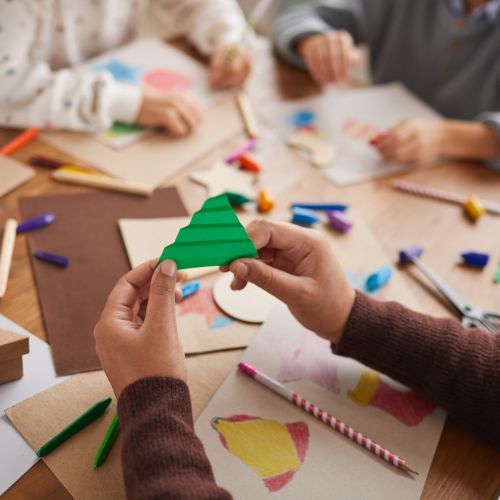
Winter invites a different relationship to creativity than the rest of the year.
As days shorten and outdoor life contracts, many families notice a change in how children attend, imagine, and work. During this season, mothers often begin looking for winter homeschool creativity—not as enrichment or entertainment, but as a way to support attention and steadiness when energy runs lower and the world feels quieter.
In winter, creativity tends to slow.
It does not present itself with novelty or enthusiasm. Instead, it emerges when children are given time, materials, and permission to remain with something simple. When the pace of the day is not crowded with transitions or expectations, creative work often takes on a different character—more sustained, less performative, and less concerned with outcome.
This kind of creativity does not aim at productivity. It develops when the atmosphere allows attention to settle and effort to remain unforced.
George MacDonald once wrote that “to be trusted is a greater compliment than to be loved.” Winter often requires this posture from the mother. Trust replaces management. Confidence replaces control. When children are trusted with time and ordinary materials, creative work becomes an act of formation rather than display. For this reason, winter homeschool creativity is not primarily about output. It is about shaping habits of attention.
As this work unfolds, the home grows steadier. The mother carries less strain. Children engage more deeply during a season that naturally turns inward.
Why Winter Creativity Matters
Children often experience winter with increased emotional sensitivity.
Reduced outdoor movement, early darkness, and disrupted rhythms affect how children regulate themselves. This is not a failure of discipline or planning. It is a physiological and emotional response to the season. Research synthesized by the Center on the Developing Child at Harvard University consistently emphasizes that self-regulation strengthens when children engage in focused, self-directed activity within calm environments. Winter homeschool creativity offers such an environment—one that supports inward energy rather than overstimulation.
Creative work also reshapes the rhythm of the day. When children draw, build, copy text, sew, cook, or work carefully with their hands, the pace naturally slows. Noise diminishes. Transitions decrease. The household moves with greater coherence. In this steadier rhythm, the mother no longer needs to manage momentum constantly.
Over time, creativity restores meaning to ordinary work. Reading feels less rushed. Writing becomes more deliberate. Art is no longer an “extra,” but a mode of attention. These shifts do not require additional instruction. They arise when the day is no longer driven by urgency.
Contemporary arts educators affiliated with institutions such as the National Gallery of Art have noted that creative engagement supports reflection and integration, not merely expression. In winter, this kind of work allows children to process experience reveals itself slowly rather than produce something quickly.
When Making Becomes a Place of Rest
Winter creativity does not depend on elaborate plans.
Simple materials often suffice when the rhythm of the home allows for sustained attention. Familiar tools—paper, pencils, yarn, text, ingredients—become adequate when children are not asked to move on too quickly. The value lies not in novelty, but in return.
Whether a child works briefly or revisits the same activity across days, the purpose remains consistent. Making anchors attention. It provides form without pressure. In this way, creative work offers steadiness rather than stimulation.
The mother’s role here is not directive. It is environmental. By protecting quiet, resisting unnecessary acceleration, and allowing work to remain incomplete, she gives creativity room to serve its deeper purpose. Nothing needs to be showcased. Nothing needs to be finished on schedule.
Where Winter Creativity Becomes Formation
Over time, winter creativity shapes more than artistic skill.
It trains patience, strengthens sustained attention, supports emotional regulation, and teaches children how to remain with something small and demanding without anxiety. These capacities extend into every other season of learning.
For the mother, winter homeschool creativity serves as a reminder that growth does not come from pressure. Her pace, her expectations, and the atmosphere she maintains already instruct her children. Much of that instruction happens quietly.
Winter is the season when formation proceeds without display.
Your home is not behind.
Your home is being formed—steadily, quietly, and in time.
To learn more about our signature free resource, The Great Pause™, check this out!


Be the first to comment